Over the past few months, one topic has come up again and again in my conversations with audit and assurance professionals: how do we deliver AI assurance? I have heard it on conference stages, in LinkedIn threads, and in the quieter chats over coffee afterwards.
The interest is real, and so is the confusion. "AI", "automation", "agents" and "models" are often used as if they mean the same thing. They don't, and the difference matters for how we assure them.
Whether governing AI agents ends up on the assurance profession's plate is still an open question. I am not going to predict the answer. What I can do is set out, in a structured way, what could be coming our way over the next few years.
This piece is a simple starting point. I hope to minimise the jargon and share a clear picture of what might land on the assurance professional's plate.
Four things that might be on your plate
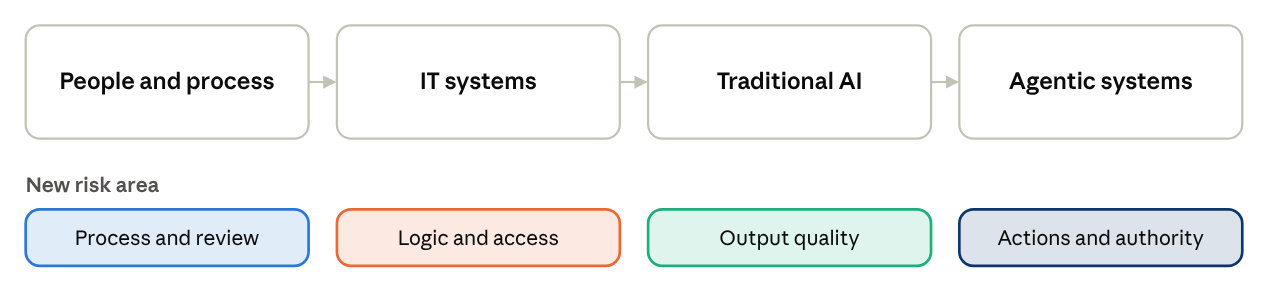
In recent years, new things have been added to what has always been on the assurance professional's plate. Today there could be three or four:
- People and process
- IT systems
- Traditional AI and machine learning
- Emerging, autonomous agentic systems
One simple question separates them: who does the work, and who makes the decision? Keep that question in mind as we go through each one.
1. People and process
People do the work. People decide.
This is where the profession started. A finance team approves invoices, a manager signs off a reconciliation, a committee reviews a policy. Assurance looks at whether the process is well designed and whether people actually follow it. This has been on the assurance professional's plate since the very beginning, so I won't go into it further here.
What we look after: segregation of duties, authorisation, evidence that reviews happened.
2. IT systems (deterministic)
Systems record and process. People still do the work and decide.
These are the systems we know well: the ERP, the CRM, the ticketing tool. They store business data and follow rules that an engineer wrote, for example "if an invoice is over £10,000, send it for a second approval". Given the same input, they give the same output every time. This is called deterministic.
This makes assurance relatively straightforward. The output is driven by fixed logic, so once we have controlled the logic, we have controlled the output.
With the output under control in this way, assurance comes down to three things:
- How the logic is designed. Are the rules right in the first place?
- How the system is implemented. Was it set up, configured and connected as intended?
- How people use it. Who has access, could someone misuse it, and is the data protected as it moves around the wider tech estate?
What we look after: IT general controls, such as user access, change management and data protection. The profession has decades of practice here as well.
3. Traditional AI and machine learning (probabilistic)
The system can now make suggestions. A person still decides.
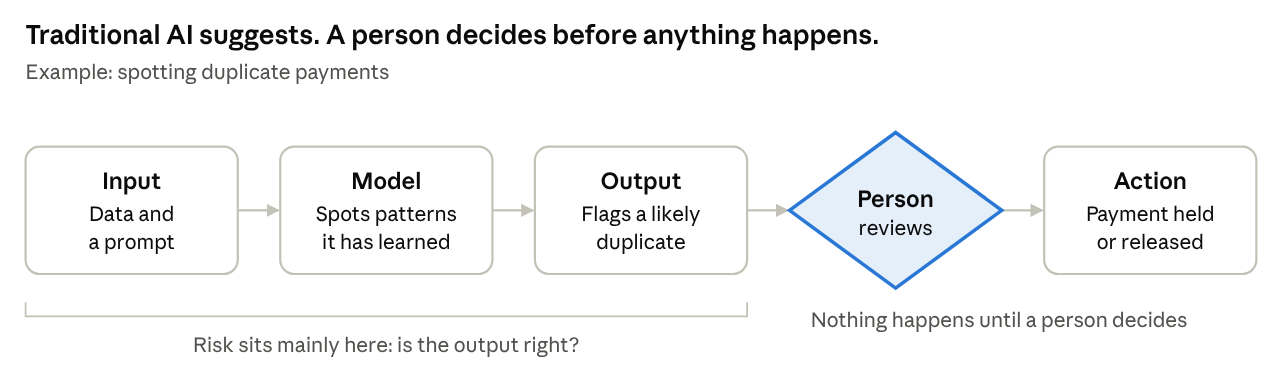
Here, AI is applied to a single, contained task. Someone provides data and a prompt, the model gives an output, and a person decides what to do with it. For example:
- a control testing engine that assesses evidence against a SOX control
- a planning assistant that drafts an audit plan from a prompt
- an anomaly detection engine that flags possible fraud or financial crime
An IT system is driven by rules: a person decides the logic and writes it into code. An AI or machine learning system is driven by data: it is shown many past examples and works out the patterns for itself.
Take a familiar example: spotting duplicate payments. A rules-based IT system might say "flag any two payments with the same supplier, amount and date". It does exactly that, every time. But it misses anything that is not an exact match: the same invoice paid to "ABC Ltd" and "A.B.C. Limited".
A traditional AI or machine learning model works differently. It is trained on vast amounts of transaction data, including payments that turned out to be duplicates. From that, it learns what duplicates tend to look like, so it can catch these near-misses too.
That makes it more capable. But when it flags a payment, there is no single rule you can point to. The honest answer to "why?" is "because it looks like something it has seen before". That is why these systems are often called probabilistic. It is also why:
- ask the same question twice and you may get two different answers
- it cannot always show you where an answer came from
This changes how we assure it. As a recent guide from Palo Alto Networks puts it, standard AI governance is more about output risk: whether a response is "accurate, fair, or compliant". The controls it describes centre on the following:
- Training data. Is the data the model learned from of good quality and fit for the task?
- Bias. Is the model checked for unfair patterns it may have picked up from past data?
- Explainability. Can we understand, at least broadly, why the model gave its answer?
- Review of the output. Does a person check what the model produces before anyone acts on it, and is the model's performance reviewed regularly?
What we look after: everything from the IT system, plus the quality of the output and of the human review.
One point worth making clear: when people raise concerns about governing AI, this is what many think about. However, the model works on an isolated task and a person stays in control. The risk sits mainly in the output, and it is relatively contained compared with what comes next.
4. Agentic systems
The system can decide and act autonomously.
This is what many recent discussions in the tech community are about. An agent does not simply answer a question. It plans a task, calls tools, moves across systems and takes action, often across many steps and without a person approving every step.
These are not yet common in our profession, but they are easy to picture. Take audit issues. An agent could pick up findings from a report, send each one to the right owner, set up follow-up meetings, track remediation updates and draft the status report for the audit committee in one sequence.
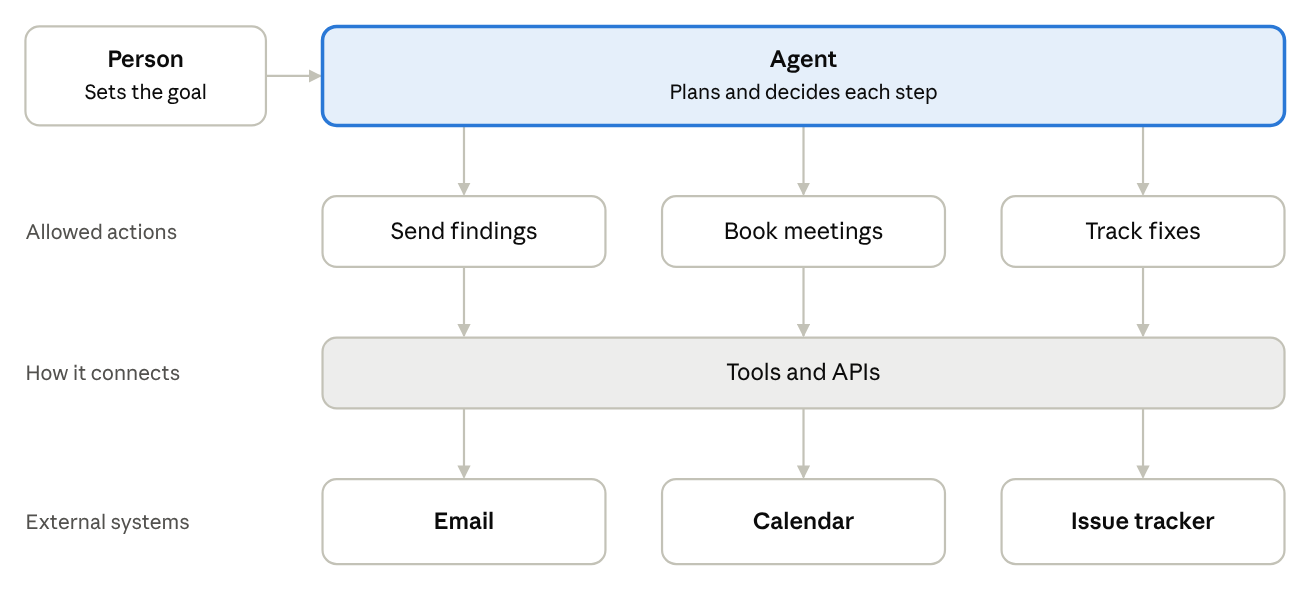
This is clearly far more capable than traditional AI. But it also challenges the safeguard we relied on before: a human decision on every output. The risk is no longer only "is the answer right?" It becomes "what is this system allowed to do, and who answers for what it did?" Some recent writing on the topic calls this the move from output risk to action risk.
A white paper from Akamai sets out how different the governance task becomes. In short:
| Traditional AI | Agentic AI | |
|---|---|---|
| Who starts it | A person, each time | The agent plans and runs multi-step tasks itself |
| What it does | Produces one output | Takes actions across several systems |
| What data it uses | A defined set | Live business data, apps and outside sources, as it goes |
| Main risks | Accuracy, bias, fairness | Data leakage, unauthorised actions, excess permissions, manipulated inputs |
| Who is accountable | The model owner | Spread across developers, deployers and connected systems |
| How it is monitored | Periodic reviews | Continuously, in real time |
What we look after: everything from IT systems and traditional AI, plus the new risks highlighted:
- Acting without sign-off. Once given a goal, an agent can keep working through steps without a person approving them.
- Using the wrong tools. An agent picks its tools as it goes, and can reach ones it was never meant to use.
- Too much access. Agents often borrow system credentials and can end up with more authority than they need.
- Data on the move. Sensitive information can pass between systems without anyone clearly seeing it.
- Agents affecting agents. When agents work together, small errors can combine into bigger problems.
- Blurred accountability. Responsibility can spread across the model provider, the platform and the organisation using it.
- Drift. Over time, what an agent does can move away from what it was set up to do, and its authority can quietly grow.
Who holds responsibility is still an open question, but it is worth setting out the current thinking. One view is that whoever deploys an agent should own it, since they decide what it is allowed to do. Another view is that a central team of specialists should take this on, because few business owners will have the expertise to oversee an agent alone. Which model wins out is yet to be seen.
Beyond the systems: what to anticipate
Sorting systems this way is a useful start. But it also raises questions that go beyond the technology itself.
- Everything at once. Most organisations already run at least three side by side, sometimes within a single process. Each part needs a different kind of assurance. How many audit plans are built to see that?
- Systems that change category quietly. An AI notetaker is a traditional AI tool. Give it a feature that sends follow-up emails and books meetings on its own, and it becomes an agentic system. So who in the organisation is checking?
- Where it sits. Is overseeing agents a first-line responsibility, a second-line risk function, or something internal audit should own? Most organisations have not yet decided.
None of these have settled answers yet. They are worth asking now, while agents are still early in our profession.
Why this matters to us at Kaption
At Kaption, we think about these questions for two reasons, even though they go beyond what most of our clients are asking us today.
First, we build and deploy both kinds of systems ourselves, traditional AI and agentic. Understanding their risks is not optional for us.
Second, we see ourselves as the AI partner for audit and assurance professionals. Our focus today is practical: giving them the capacity, coverage and timely insight to spend less time on groundwork. If governing agents does become a key area, we want to be ready to work alongside organisations, and to build what professionals need to keep these systems under control.